The 18-Month Problem
By the time the failure is visible, the window to fix it has already closed.

AT THE INFLECTION · Inflection Strategy · Larry Chaityn
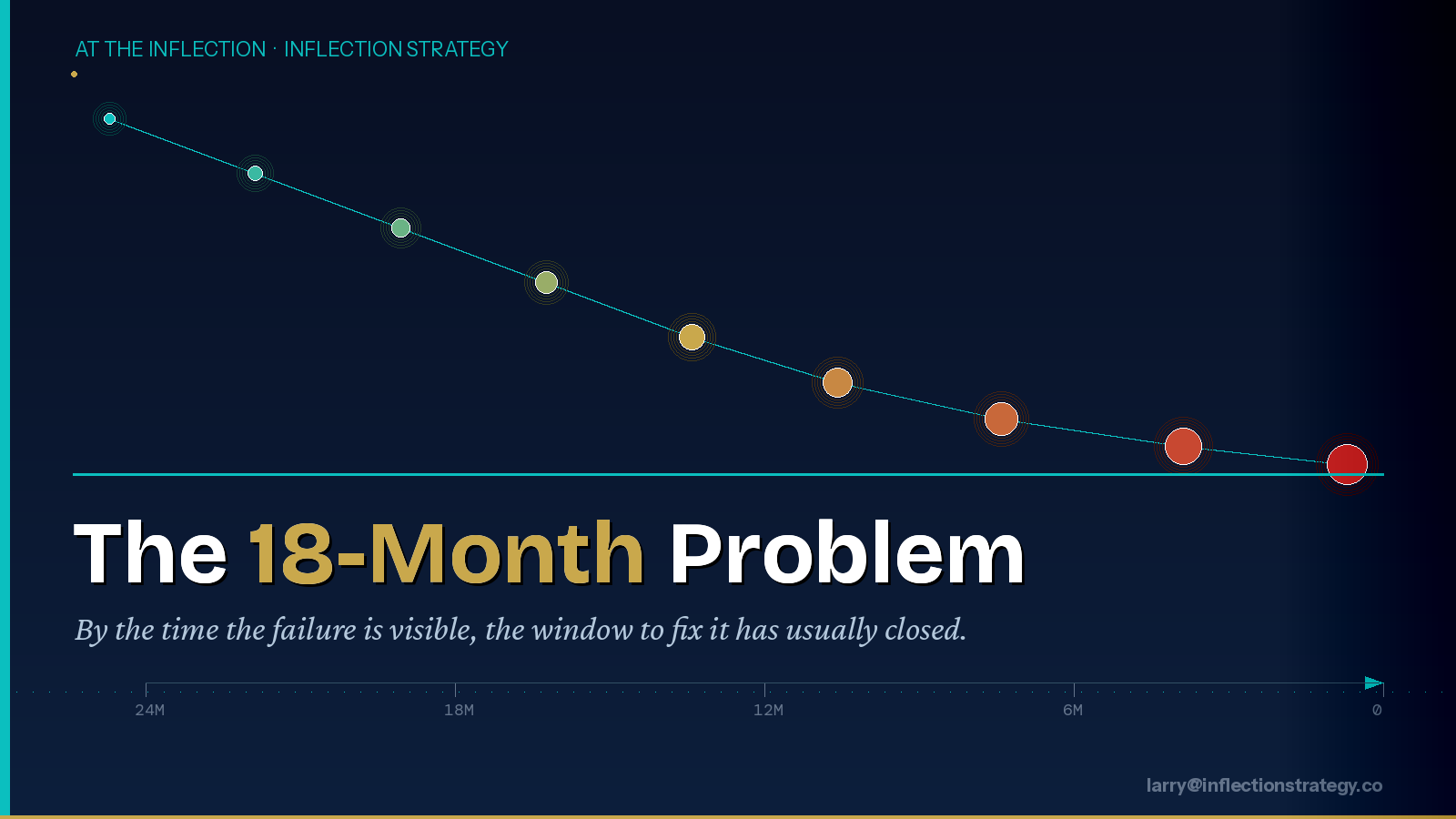
The 18-Month Problem
By the time the failure is visible, the window to fix it has already closed.
The ISF finds the upstream misstep while the downstream options are still open.
Three things happened last year that looked like three different problems.
A CEO received a Complete Response Letter eight months into FDA review. Not on efficacy. Not on safety. On manufacturing documentation — for the second time, on the same grounds.
A CEO whose gene therapy had posted exceptional Phase 3 data watched the launch produce one commercially reimbursed patient in Year 1 — out of an addressable population the commercial model had projected in the hundreds. The revenue forecast had assumed 65% payer coverage. Nobody had verified that assumption before enrollment began.
A CEO who had been reporting 20% revenue growth cut ten percent of the workforce after two Phase 3 failures and a BLA rejection in the same fiscal year.
Three departures. Three different companies. Three different therapeutic areas. One pattern.
The organizational failure that ended each of those tenures was not produced at the moment it became visible. It was produced 12 to 18 months earlier — in decisions nobody flagged, assumptions nobody tested, and seams between functions that nobody owned.
This is the 18-Month Problem.
Not a single failure. A chain. And the chain has a first link.
The companies that navigate inflection points well are not the ones with better science or larger teams. They are the ones that found the first link while the downstream options were still open. Most companies find it after the marble has already dropped.
How the Chain Works
Organizational domains in late-stage biotech do not fail independently. They are a linked system. The output of each domain becomes the input condition for the next. When one domain has a gap — an ungoverned seam, an untested assumption, a missing capability — that gap does not stay local. It degrades the input quality for every domain downstream, compounding quietly until the cascade becomes a catastrophe.
Here is what that looks like in practice — traced from a single upstream gap to a commercial failure:
1. A company does not engage payers early enough to understand what evidence they need for a coverage decision.
2. Without knowing what evidence payers need, the clinical team designs the trial for FDA — not for the payer’s economic argument.
3. The trial completes. The data that payers require to justify coverage at the price point was never captured.
4. At approval, the HEOR model cannot make the economic argument the payer needs. It is built on clinical endpoints, not cost-offset evidence.
5. The first major payer coverage decisions come back with restrictive criteria. The commercial model, built on 65% coverage within 12 months, is no longer viable.
6. Revenue misses in Q1. Capital position weakens. The label expansion that would have justified the price cannot be funded.
7. The board asks why the HEOR model didn’t anticipate this. The answer: nobody asked the payer what evidence they would need before the protocol was locked.
↓ The window to fix it closed 18 months before the PDUFA date — when the trial protocol was locked.
Seven consequences. One origin. One window — open for a specific period of time — that is now permanently closed.
Two Scenarios — Read These and Ask Yourself If You Recognize Them
The following scenarios are composites drawn from the ISF case library. No company is named. Every pattern is real. If either of these sounds like something happening in your organization right now — the chain may already be running.
Scenario 1 The Reimbursement That Wasn’t There
The situation
A late-stage biotech has a gene therapy for a rare pediatric disease approaching its PDUFA date. The science is exceptional. The Phase 3 data is compelling. The commercial team is hired and deployed. The revenue forecast — approved by the board — assumes 65% payer coverage within 12 months of approval, based on the therapy’s clinical superiority. Nobody has had a substantive conversation with a major payer’s medical director. The HEOR model was built by the clinical team using trial endpoints. The market access function was hired eight months before launch. They inherited the forecast. Nobody told them it was built on an assumption.
The chain that was already running
Fourteen months before the PDUFA date, the window to redesign the payer engagement strategy was still open. The trial was still enrolling. The real-world evidence protocol could still have been written to capture the cost-offset data — hospitalizations avoided, disease progression slowed, caregiver burden reduced — that payers need to justify coverage at the price point. Instead, the clinical team designed the trial for FDA. The commercial team designed the launch for the forecast. The market access function was not in the room for either conversation. The assumption that payers would follow the clinical evidence was never classified as an assumption. It became a fact — unexamined, unverifiable, and already foreclosing options by the time anyone thought to test it.
The moment of recognition
The therapy worked. The patients needed it. The company could not get it to them at a price the system would pay — because the organizational chain that should have connected trial design to payer strategy to commercial infrastructure had never been built. The window to build it had been open. It closed fourteen months before the PDUFA date. Nobody noticed it closing.
The question that would have interrupted the chain — 18 months earlier
Does your market access team have a seat in the room when your trial protocols are designed — or do they inherit a revenue model built on clinical assumptions they had no part in making?
Scenario 2 The Manufacturing Problem Nobody Owned
The situation
A mid-size biopharma has spent four years and four hundred million dollars developing a novel gene therapy. The BLA is filed. The FDA review is underway. The regulatory affairs team is confident — strong FDA relationship, clean clinical data, well-constructed submission. Eight months into the review, FDA sends a Complete Response Letter. Not on efficacy. Not on safety. On manufacturing documentation. Specific deficiencies in the Chemistry, Manufacturing, and Controls section that the company believed had been addressed. This is the second CRL this program has received on manufacturing grounds. The first, eighteen months ago, resulted in a resubmission that the company believed had fully addressed FDA’s concerns.
The chain that was already running
The regulatory affairs VP and the VP of Manufacturing had a good working relationship. They spoke regularly. But their conversations were about milestones and timelines — not about whether the manufacturing documentation was being built to the standard FDA would apply to a novel modality with limited approval precedent. FDA had been signaling its evolving standard for this class of therapy across advisory committee meetings and guidance documents over the preceding two years. The regulatory intelligence function was monitoring the clinical and safety signals. Nobody had specifically tracked the manufacturing standard signals. The seam between them — the interface where manufacturing quality meets regulatory strategy — had no owner. No meeting. No shared accountability. No mechanism for either team to challenge the other’s assumptions about what FDA now required.
The moment of recognition
After the second CRL the board asked the CEO how this had happened twice. The CEO asked the regulatory VP. The regulatory VP asked the manufacturing VP. The manufacturing VP said they had met every specification in the submission agreement. The regulatory VP said the specifications were based on manufacturing’s assessment of what was achievable — not on FDA’s current standard for this modality. Both were right. Neither had been wrong in their own domain. The failure lived in the space between them. The program was delayed by fourteen months. The company raised emergency capital at significant dilution. The CEO did not survive the second board meeting.
The question that would have interrupted the chain — 18 months earlier
When did your regulatory team last have a substantive conversation with FDA about your manufacturing — not a submission, a conversation? And who in your organization owns the question of whether your manufacturing documentation is being built to FDA’s current standard for your specific modality?
The Question Worth Asking This Week
Both scenarios describe companies that were doing everything right — in their own domains, by their own standards, according to their own timelines. The regulatory team was executing. The commercial team was deploying. The clinical team was delivering.
The failure was not in any one domain. It was in the space between domains — in the ungoverned seam, the untested assumption, the chain that was already running before anyone thought to look for it.
The 18-Month Problem is not a scientific problem. It is not a talent problem. It is an organizational architecture problem — and it is almost always invisible until the window to fix it has closed.
The question is not whether your organization has gaps. Every organization at this stage has gaps. The question is whether you know which gaps are in the chain — and whether the window to close them is still open.
If your PDUFA is within 24 months: the window may still be open. Barely.
If your Phase 3 data readout is within 18 months: the upstream decisions that will determine your commercial outcome are being made right now.
If you have already launched and revenue is underperforming: the chain ran. The ISF tells you where it started and what it would take to interrupt the next one.
About the Inflection Strategy Framework
The ISF is a structured organizational diagnostic built from twenty-five years of pattern recognition and grounded in named company failures. It covers 22 domains, 72 sub-domains, and 301 diagnostic questions — each traceable to a specific organizational failure at a specific biotech inflection point.
It is not a generic consulting review. It is a systematic method for finding the first link in the chain — the upstream misstep that is compounding quietly toward a downstream catastrophe — while the options to interrupt it are still available.
An ISF engagement takes 4 to 6 hours of leadership time and produces a scored readiness assessment across all 22 domains, a root cause analysis of identified gaps, and a prioritized remediation roadmap with timelines.
It is designed for 12 to 18 months before the inflection point. Not as a preference. As the condition on which the entire value of the diagnostic depends.
If Either Scenario Felt Familiar
The chain may already be running. The question is whether the window is still open.
I conduct a limited number of confidential CEO-level conversations each quarter. Not a pitch. A structured diagnostic conversation — 60 minutes — to determine three things:
1. Whether the cascade is already running
2. How far it has progressed
3. Whether you still have time to interrupt it
larry@inflectionstrategy.co | inflectionstrategy.co
Inflection Strategy · Larry Chaityn · Where execution fails, talent was load-bearing.